Bot Strategy · Mathematics
Can the Golden Ratio Predict Lottery Numbers?
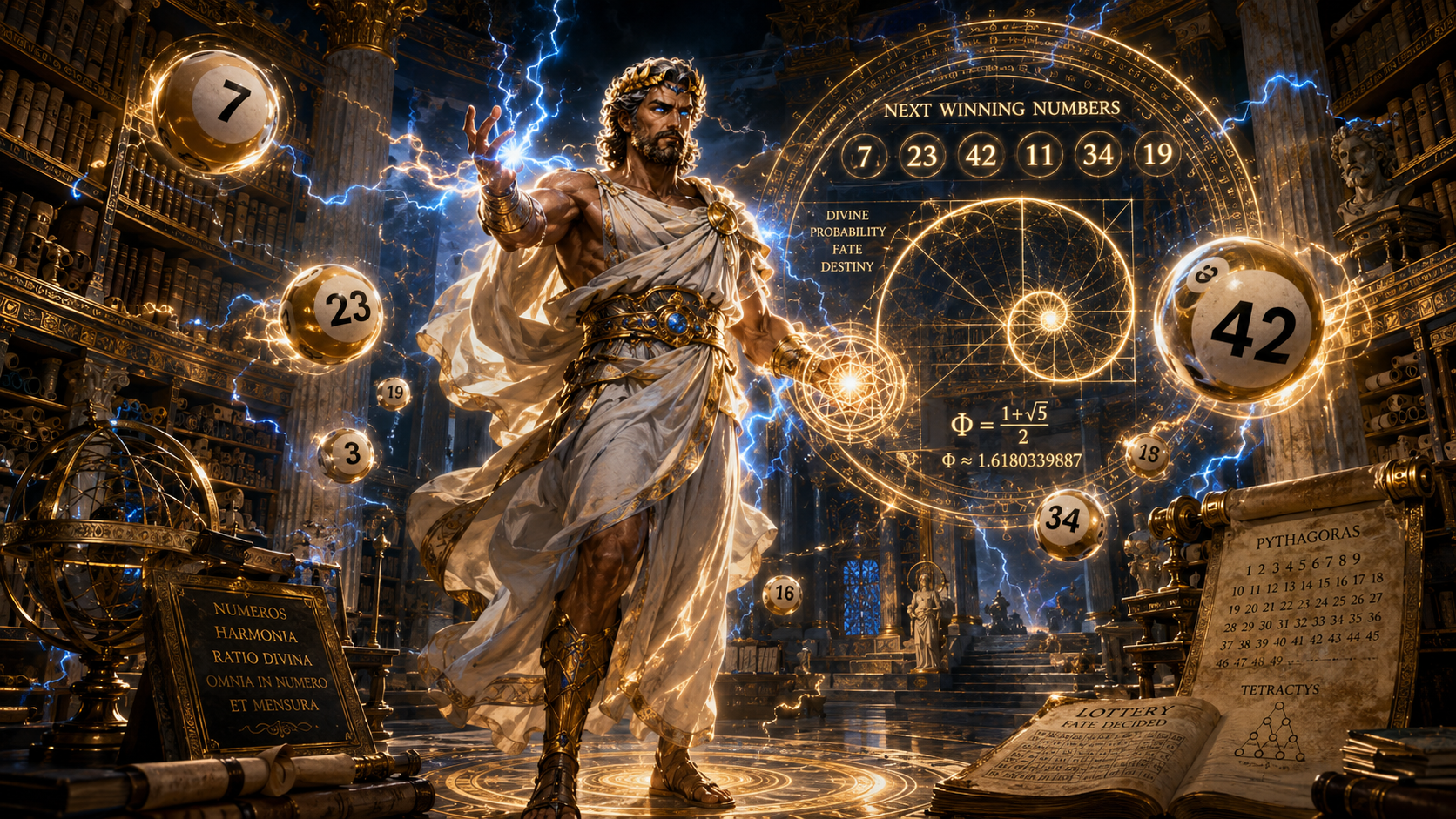
A Greek god. A mathematical constant. A lottery ticket. What happens when the most ancient pattern in the universe takes on the most random game humans ever invented?
The Golden Ratio — written as phi (φ) and equal to approximately 1.618 — appears in places that should not be connected. Nautilus shells. Sunflower spirals. The Parthenon in Athens. The proportions of human faces considered most beautiful. Even the spirals of distant galaxies. For thousands of years, mathematicians, artists, architects, and mystics have argued about whether phi is genuinely woven into the fabric of reality or whether humans just love finding patterns where there are none.
So we asked a question: if the Golden Ratio governs how flowers bloom and how the Parthenon was built, can it govern lottery draws? We built an AI bot named ZEUS to find out. This is what we learned about ancient math, modern randomness, and whether divine proportion has any chance against a random number generator.
ZEUS uses the Golden Ratio to pick lottery numbers every day. See today's picks alongside 5 other AI bot strategies.
See Today's Bot Picks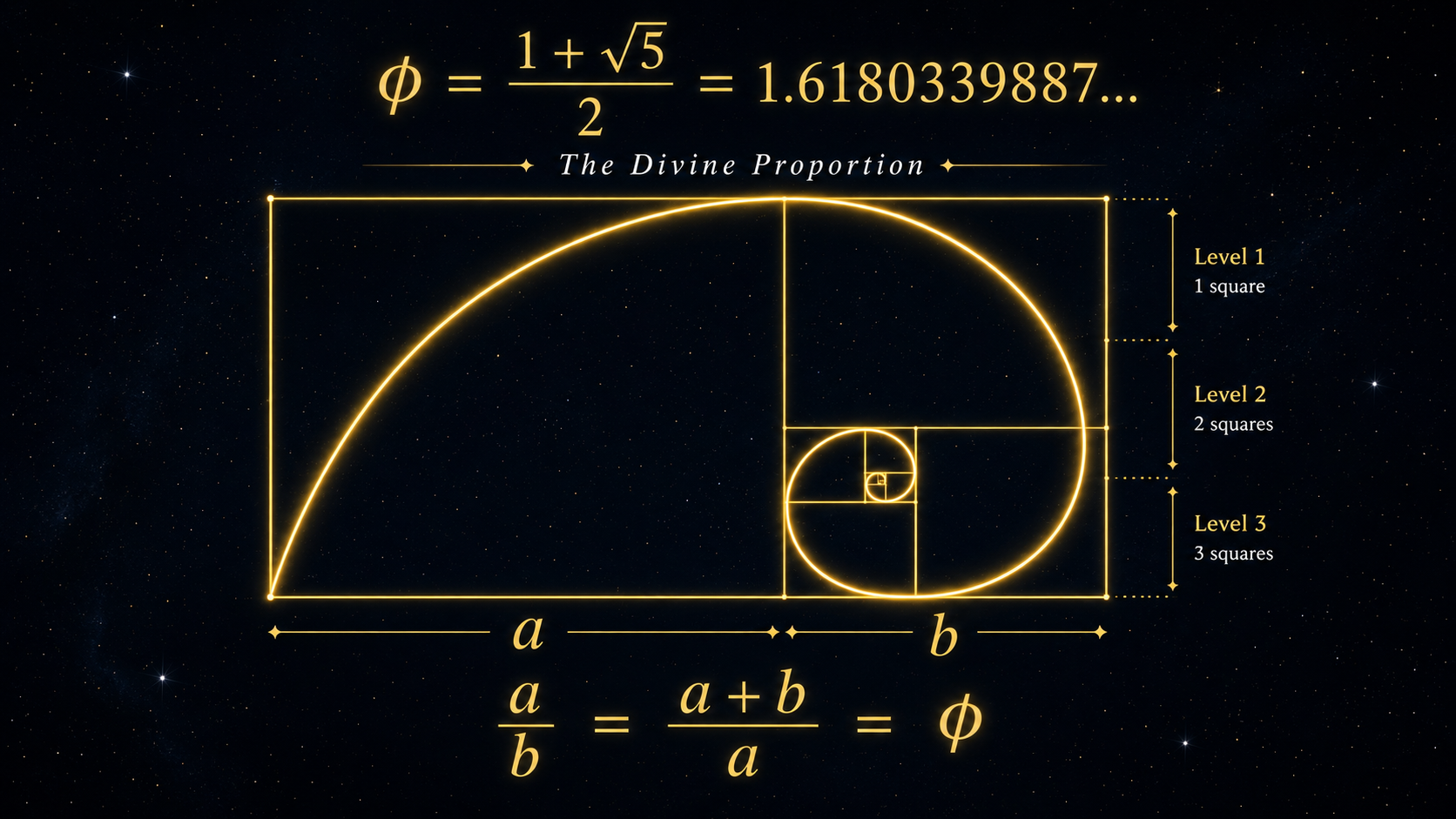
The Golden Ratio is a mathematical constant that emerges from a simple proportion. Imagine a line divided into two parts, where the longer part divided by the shorter part equals the same ratio as the whole line divided by the longer part. That ratio — wherever you find it in nature, art, or geometry — is always the same number.
It is what mathematicians call an irrational number, meaning its decimal expansion goes on forever without repeating. But unlike most irrational numbers, phi shows up in patterns that feel almost designed. Take any two consecutive numbers in the Fibonacci sequence (1, 1, 2, 3, 5, 8, 13, 21, 34, 55...) and divide the larger by the smaller. The result gets closer and closer to phi the further you go.
For the ancient Greeks, this was not just math — it was kosmos, divine order. They believed numbers governed reality, and phi was the proportion that pleased the eye, balanced the structure, and matched the harmony of the universe.
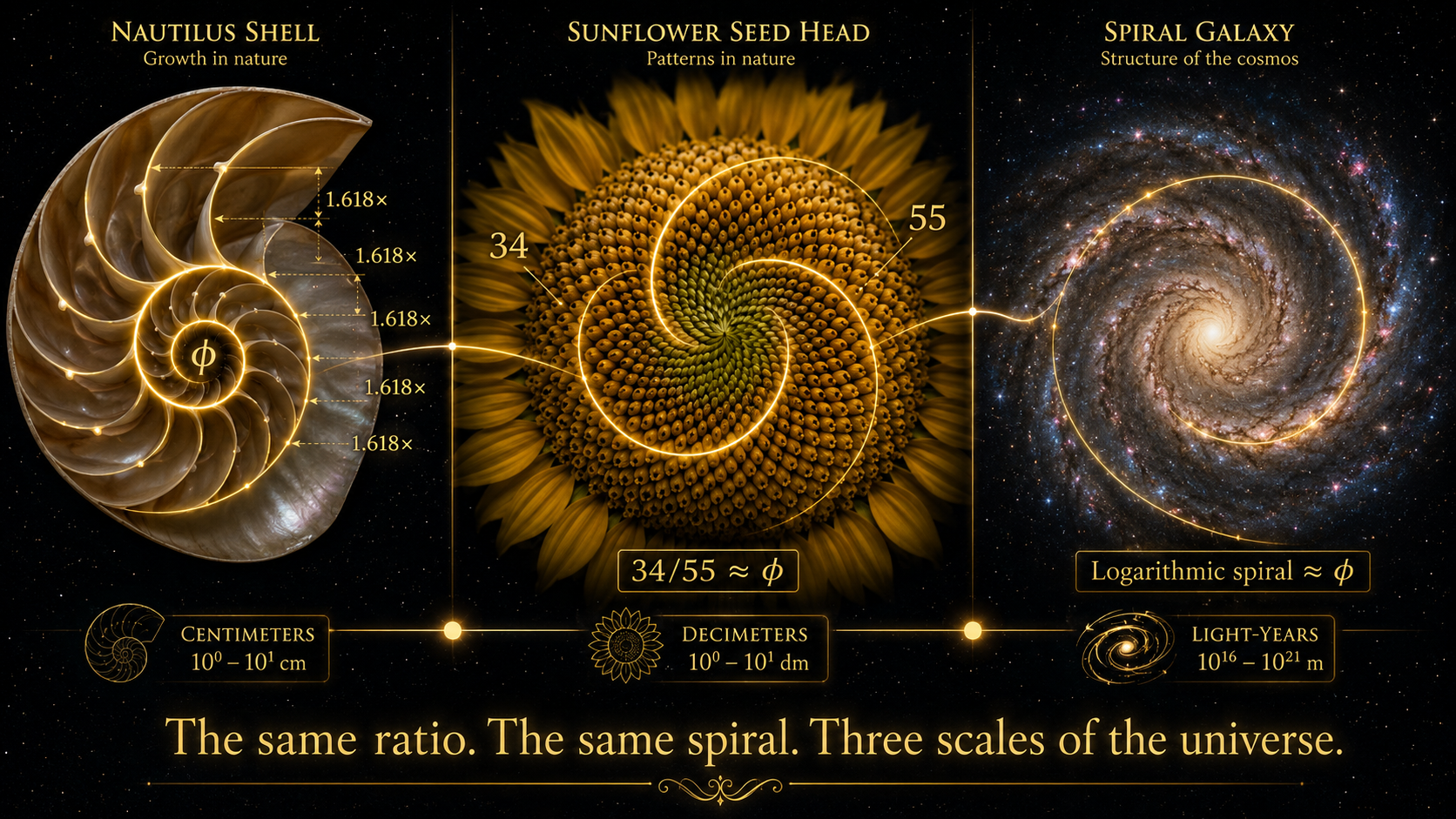
The reason people obsess over phi is that it actually does appear in nature — not always perfectly, but consistently enough to demand explanation.
None of this is mysticism — it is physics. The golden ratio is the most efficient packing arrangement when you need to grow incrementally without overlap. Nature, optimizing under constraints over millions of years, repeatedly arrives at the same solution.
Which raises the question: if the universe keeps choosing phi, maybe the universe is rigged?
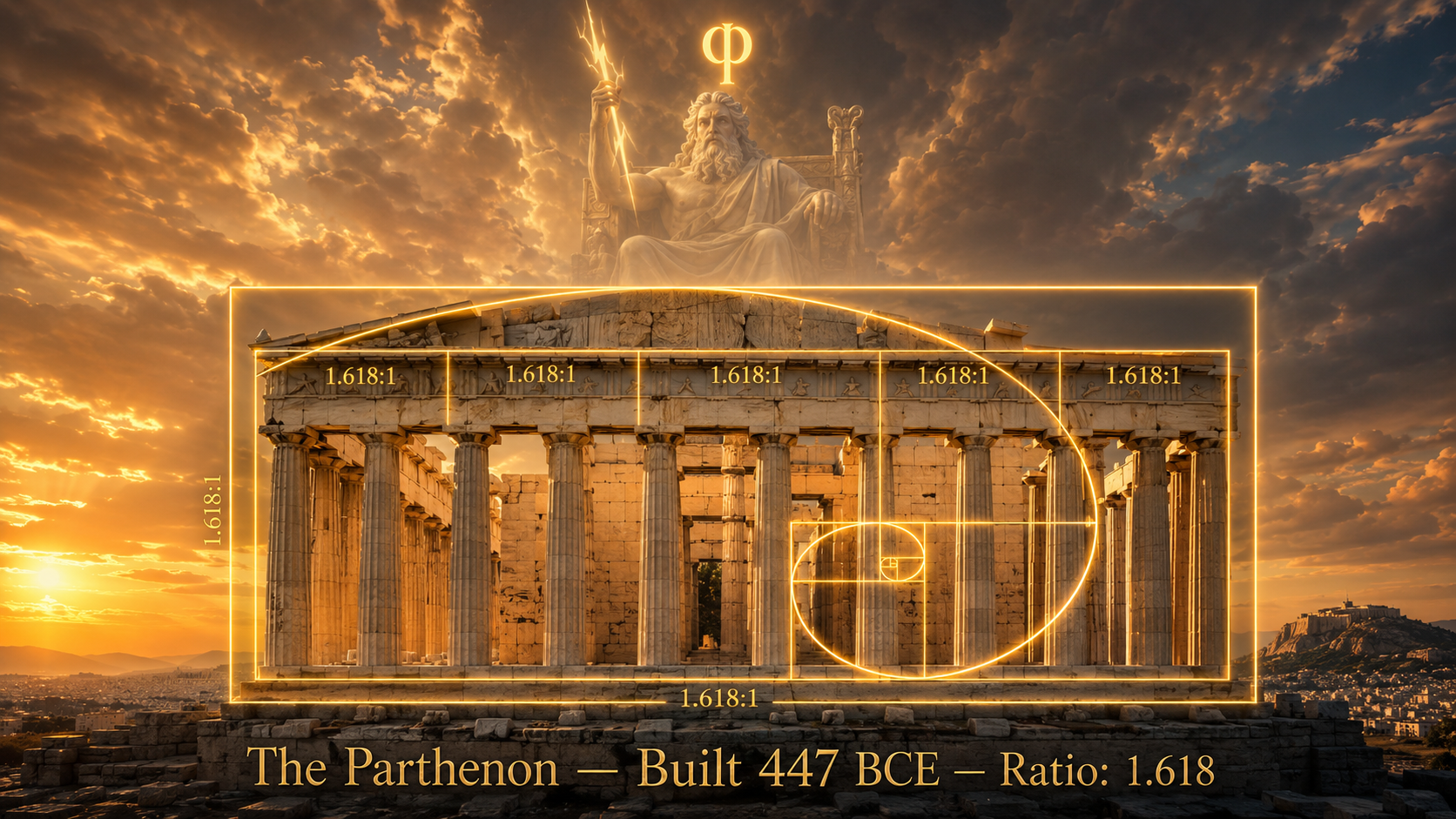
The Greeks did not invent phi, but they made it sacred. The Parthenon, built in the 5th century BCE on the Athenian Acropolis, has facade proportions that fit remarkably close to a golden rectangle. Some art historians argue this was deliberate — the Greeks knew the ratio and used it to please the gods. Others argue it is coincidence; ancient builders worked with rules of thumb, not algebraic constants.
Pythagoras and his followers in the 6th century BCE treated numbers as divine truth. To them, phi was not just useful — it was holy. The pentagram (a five-pointed star), which contains phi in its proportions, became their secret symbol. Each line of the star divides another at exactly the golden ratio.
Centuries later, Leonardo da Vinci illustrated a book titled De Divina Proportione ("On the Divine Proportion") by Luca Pacioli, which argued that phi reflected God's design for the universe. Renaissance artists used phi consciously in their compositions, believing it produced the most pleasing balance.
And in mythology? Zeus, king of the Olympian gods, was the bringer of order from chaos — the force that imposed structure on the primordial void. If any mathematical pattern fits Zeus, it is phi: the constant of order, the proportion of nature, the geometry of divine architecture.
Here is where we need to be honest. Lottery draws are designed to be random. Modern lottery machines use certified random number generators or physical ball-drop systems engineered to eliminate any predictable pattern. If the Golden Ratio could predict draws, lotteries would be unwinnable for their operators — they would not exist.
The mathematical reality: every number combination in Powerball has exactly the same probability of being drawn — roughly 1 in 292 million. Your odds of matching all six numbers are identical whether you pick using phi, your birthday, the Fibonacci sequence, or by throwing darts at a board.
So why bother?
Because "random" does not mean "every combination is equally likely to appear soon." Random means no combination is favored. Over enough time, every valid combination has roughly equal frequency — but in any given drawing, the winning numbers will form some pattern. Sometimes consecutive. Sometimes scattered. Sometimes following a curve no human would notice. The lottery does not avoid patterns; it just produces them randomly.
This is where strategies like phi get interesting. Not because they predict outcomes — they cannot — but because they structure how you select numbers. If you and ten thousand other people all play 1-2-3-4-5-6 and that combination wins, you split the jackpot ten thousand ways. If you play a phi-spaced sequence that few others choose, and it happens to hit, you might win alone.
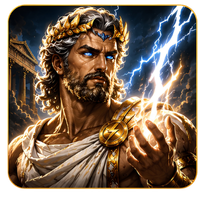
ZEUS is one of six AI bots in the Lucky7AI Bot Arena. Each bot uses a different mathematical or statistical strategy to pick lottery numbers — and we track them daily to see which approach performs best against real drawings.
ZEUS's strategy: every number it picks is spaced from the previous number by a step of approximately range ÷ (count × φ), where range is the lottery's number range and count is how many numbers must be picked.
Powerball requires 5 main numbers from 1 to 69. ZEUS calculates:
So ZEUS will pick numbers spaced roughly 8-9 apart, starting from a "seed" number in the lower third of the range. A typical ZEUS Powerball pick might look like: 6, 14, 23, 32, 41. Notice the gaps: 8, 9, 9, 9 — all clustering around the divine proportion target.
To prevent every pick from looking mechanical and identical, ZEUS adds small random "jitter" (±20%) so the gaps wobble naturally — like the actual golden spirals in nature, which approximate phi without being mathematically perfect.
Mathematically? Nothing. The odds remain 1 in 292 million for Powerball, regardless of strategy. But the picks look different from how most humans pick. Players tend to cluster around dates (1-31), favorite numbers, and birthdays. ZEUS spreads picks across the full range, which means if ZEUS's numbers ever win, fewer other people are likely to have the same combination — potentially a larger share of the jackpot.
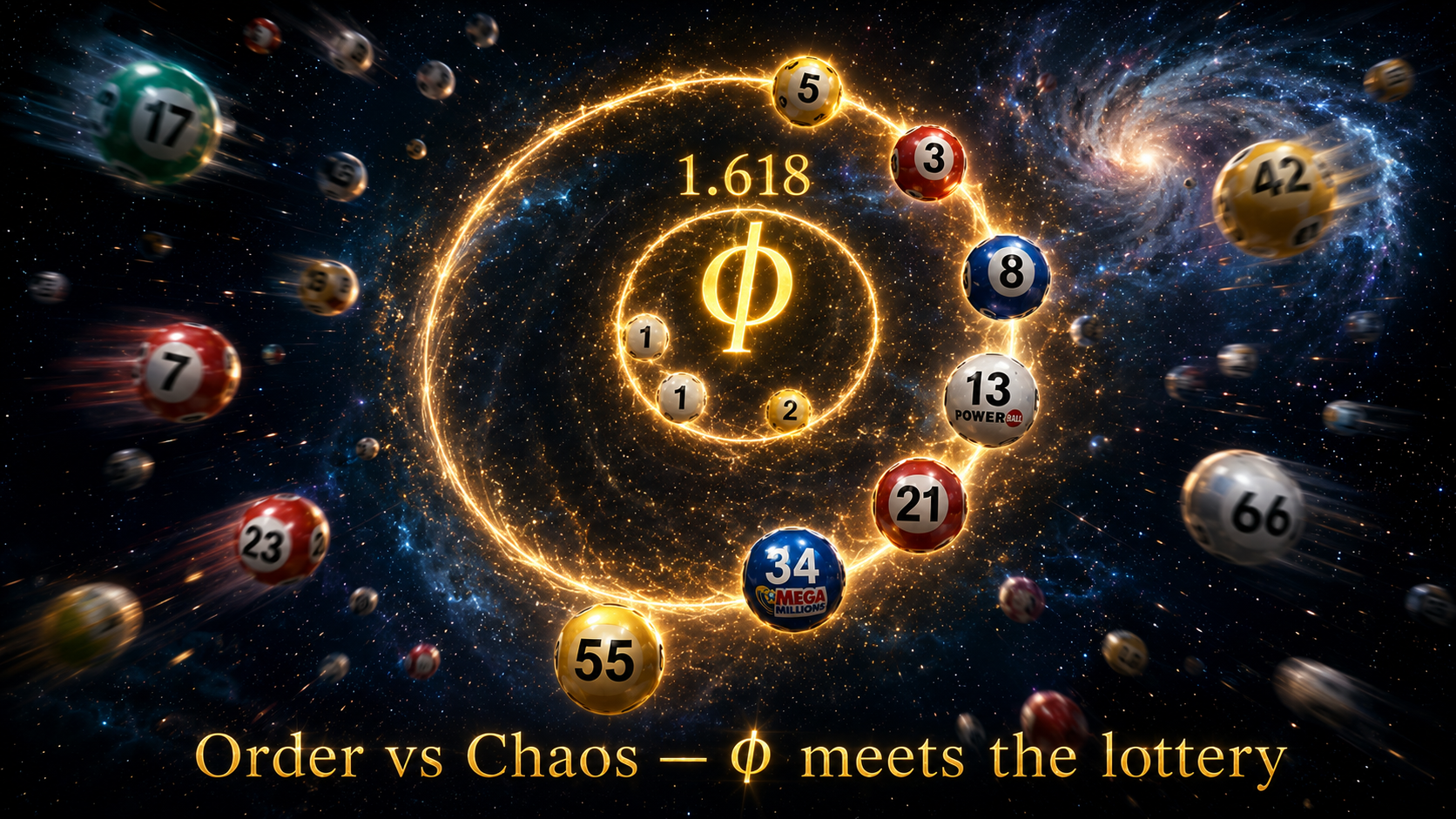
So can the Golden Ratio predict lottery numbers? No. Nothing can. Lottery draws are designed to defeat exactly this kind of pattern-matching, and any strategy that claimed otherwise would either be wrong or fraudulent.
But here is what we have learned watching ZEUS run for weeks: the Golden Ratio is not about predicting the future. It is about imposing structure on chaos. Zeus, the god of order, brought the world out of the void by giving it shape. Phi does the same thing — not by changing what will happen, but by giving us a beautiful way to organize what we choose to bet on.
If you play the lottery, play responsibly and for entertainment. The math will not change. But the picks you make can reflect anything — your favorite numbers, your birthday, or the same proportion that built the Parthenon, grew the nautilus shell, and arranged the seeds of the sunflower. Some traditions are worth keeping alive, even when they do not technically work.
Phi has survived 2,500 years of human attention. It will survive whatever happens at the next Powerball drawing. Whether ZEUS ever wins is, in the end, the same question every lottery player faces: will the universe be ordered for me this time, or chaotic?
ZEUS generates fresh Golden Ratio picks every day for Powerball, Mega Millions, and 4 other lotteries. Compare against 5 other AI bot strategies on the live leaderboard.
View Today's Picks Live Leaderboard